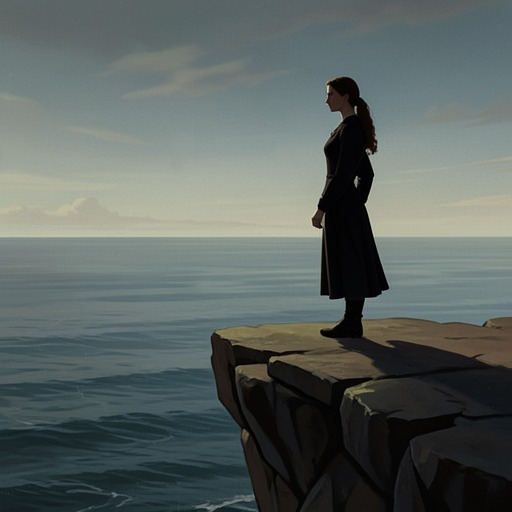
Seaside Cliffs
Three Bags FullThe Seaside Cliffs are both a lookout and a refuge in the flock’s landscape: from their heights, Zora can watch the shore and see events that other sheep cannot, while the drop below makes the cliffs a place of danger. The contrast between sheep’s surefootedness and human unease on the heights gives the setting a distinct place in the story.
Setting and vantage
A narrow rocky ledge near the top of the cliffs is one of the flock’s watch posts. When Miss Maple assigns lookouts, Zora takes this position because she has a good head for heights; from it, she can watch the Beach Below the Cliffs. Zora claims descent from a wild mountain sheep, and her confident movement above the drop lends that claim some credibility.
The ledge gives Zora a perspective unavailable to the sheep on the hill. When panic scatters the flock, she retreats to the rocks and is the only sheep who can see what is happening between Othello and the gray wolfhound. The cliffs thus serve not simply as scenery but as a practical vantage point from which an unfolding threat becomes legible.
Zora and George on the heights
Zora’s ease above the drop contrasts with the humans’ fear of it. She observes that people turn pale and clumsier when they venture too close to the cliff edge. George keeps a safer distance when Zora jumps onto her favorite ledge; unable to lure her down with blandishments, he calls to her and throws dirty tufts of grass and dried sheep droppings.
Their exchange becomes a recurring, comic contest of perspectives. When George’s missiles reach people below, he crawls toward the edge to see whether a tourist or villager has been struck, while Zora watches from her ledge. They look at one another and understand each other perfectly: the shepherd grinning on the ground and the sheep perched above him. For Zora, the episode confirms how much better people might fare if they moved on four legs.
Threats above and below
The cliffs become a place of refuge during the wolfhound’s attack. As the flock flees, Othello confronts the dog on the hill near George’s Place. From her ledge, Zora sees Othello attack, turn, and charge again; the dog falters and swerves before the collision. Othello’s unexpected aggression and speed reverse the apparent balance of danger, while Zora’s elevated position lets her witness the change.
The cliffs also overlook the aftermath of a fall. After the wind clears the mist around midday, Zora goes to the edge and the sheep see the butcher lying on a small patch of sand among the rocks below. He appears motionless, and the flock takes pleasure in the sight; then his left eye opens and searches across the sheep before closing again. The sudden movement turns their satisfaction into fear, and they retreat cautiously from the cliff tops. The setting’s height offers safety and perspective, but what lies beneath it remains perilously close.